Friday, October 28, 2016

Superb Bird-Of-Paradise: A Master of Disguise

Superb bird-of-paradise
mid-transformation

Birds of paradise are some of the most colorful and eye-catching exotic birds on the planet. Among them is the striking superb bird-of-paradise or Lophorina superba, which is native to the rainforests of New Guinea. These little creatures measure around 10 inches and are known mostly for the males' frankly hilarious mating display.

When at rest, the male superb bird-of-paradise is relatively normal in appearance. It does have bluish-green iridescent feathers at its chest and head, but that is all that is visible. However, this bird is hiding some special features that he uses to attract a mate. The pretty feathers at his chest are actually part of a shield. Some of the black feathers along his back are part of what is known as his cape. He can manipulate the colored feathers on his head and some black ones along his bill in conjunction with these other parts to masquerade for the ladies.

After meticulously cleaning an area on a branch, the male superb bird-of-paradise calls out to the honeys. When one approaches, he lifts his breast shield, cape, head and bill feathers until they line up to give him the appearance of a deep black elliptical creature with shining blue-green markings. Once he's got the right look, he hops about on his branch, making sure to keep his huge disguise facing his potential mate. While he hops, he snaps his tail feathers together, creating a sharp, repetitive clacking noise.

In contrast, the females and young of the species blend into their surroundings. They have reddish-brown uppers with brown chests and bellies. These ladies don't let their average looks stop them from being notoriously picky. There are more of them than there are of the flashy males, so they feel comfortable refusing up to 20 potential mates before finally settling in to make a family.


Wednesday, October 12, 2016

The Beast of Bray Road: A Curious Cryptid


The Beast of Bray Road is a creature that witnesses claim to have seen in Racine, Walworth and Jefferson counties in Wisconsin. The first reported sightings of the creature happened on Bray Road near Elkhorn, Wisconsin. These sightings are what lent the beast its name. However, sightings do not only occur on Bray Rd. In fact, the beast has not been sighted there since the early 1990s.

No one knows what the Beast of Bray Road, also known as Manwolf, is. Some people believe it is a werewolf, others that it is a Bigfoot and, of course, there are people who believe that it is some heretofore-unknown species. There really is no way to know unless a specimen is found. There is also the possibility that they Beast of Bray Road is, in fact, some creature that we are well aware of that simply scared some people enough that they believed it was something bigger and scarier than it really is. Common theories as to what known animal the beast could be include wolves and bears.

The creature is described as around 6 ft. tall with grayish and brown fur. Its face is said to resemble a wolf, and its ears are pointed. It has three long claws on each hand/paw. It has shiny yellow eyes. Its body has been likened to that of a lean, muscular man that tends to sit back on its haunches or kneel.

The Beast of Bray Road can run and walk on all four of its legs or just its hind legs. It has been seen eating its prey or its scavenged carrion in its hands with its palms facing upward. It has never attacked anyone, but some witnesses claim that it has acted aggressively toward them. This aggressive behavior includes running at people and jumping on their vehicles. The creature’s diet is not known for sure, but it has been seen eating the carcasses of small road kill.

Sightings of the Beast of Bray Road may go back as far as the 1930s. However, it wasn’t sighted frequently or reported thoroughly until 1989 through 1992. Most of the sightings have occurred when one or more people stumbled upon or drove past the animal while it was eating or possibly hunting/scavenging. Sightings of the animal have tapered off since the 90s, but the creature can supposedly still be seen in the woods of the area.

Perhaps the Beast of Bray Road is some cousin of other cryptids in the United States. Alternatively, it could simply be an animal that has yet to be classified or captured, which would make it a true cryptid. It could also be a group of wild animals that has become so adjusted to human life that individuals feel comfortable approaching people and vehicles. It could also be that people are frightened enough to see more than what is really there. Whatever the Beast of Bray Road is or isn't, we will never know until one is captured or it is conclusively proven that the Beast of Bray Road is a case of mistaken identity, which would be difficult to do.

Sources

Creature History, Evidence and Happenings, retrieved 11/24/09

Sunday, October 2, 2016

Freshwater Sharks

Northern River Shark
CSIRO National Fish Collection

Most of the world’s shark species are found in the ocean, but there are some elusive and not so elusive sharks out there that live in freshwater. Granted, there are only two types and possibly only five or six species of freshwater sharks, but they do exist and at least one is quite dangerous.

Bull Shark


Bull sharks are typically found in rivers or near warm shores in tropical areas. However, these animals are not strictly fresh water dwellers. Some of them spend all of their time in fresh water, while others swim to salt water for mating and birthing. They are able to transition between the two because they have the ability to control the amount of urea and sodium in their bodies. They also urinate frequently to rid themselves of excess fresh water.

Bull sharks are medium-sized sharks that are grey on their top half and white on the bottom. They have short, blunt noses that they use to head butt their prey before attacking. They weigh between 200 and 500 pounds and can be up to eight feet long. On average, they live about 16 years. Their diet consists of just about any meat that swims near them, so humans should be weary in areas where bull sharks have been sighted. Bull sharks are one of the three most dangerous shark species in the world.

River Sharks


River sharks are some of the most elusive and rare fish species on Earth. We don't know much about them. For the most part, their diet, mating habits, populations, behavior, life expectancy, specific locations and size are all mysteries. It is believed that they eat fish, though not enough research has been done on them to know for sure. They are also believed to spend their entire lives in rivers, making them the only true fresh water sharks in the world. To date, there are only around five known species, two of which may actually be one and the same. Of the five known species of river sharks, the speartooth river shark and the New Guinea river shark may be the same. The other three species include the Ganges river shark, which is critically endangered, the Bizant river shark and the Borneo river shark.

So you see, there are freshwater sharks in the world. In the case of the bull shark, we can only marvel at its adaptations and avoid its aggressive behavior. In the case of river sharks, we can only hope that we will be able to obtain more information about these creatures in the future.

Monday, September 26, 2016

Saint Dane: A Hybrid Sweetheart

Saint Danes are a hybrid mix of the Saint Bernard and Great Dane dog breeds. They are also known as Great Bernards. They are usually bred by mating a purebred Saint Bernard with a purebred Great Dane. A mixture of either of these breeds with a Saint Dane will also produce a Saint Dane.While Saint Danes are not purebred dogs, they are also not mutts. They are not mutts because their lineage is traceable on both sides to purebreds or to Saint Danes who have purebred lineage.  That is what makes Saint Dane a hybrid breed.

A hybrid dog breed’s appearance and behavior is best assessed by looking at both parent breeds. This is a good way to guess how the animal will behave and what their needs will be.

Saint Bernard

Saint Bernards are huge dogs. Their minimum adult height is 2 feet 3 inches and their adult weight ranges between 130 and 180 pounds. They were initially bred as guard and rescue dogs so they are very powerful. They also have an excellent sense of smell.

Saint Bernards are typically white with brown markings all over their bodies. They can have long or short hair and they shed a lot. They need frequent grooming. They also have very large heads and they drool constantly.

Despite their size, Saint Bernards are fantastic family dogs but because of their size, they should be monitored around small children. It is very easy for a full-grown Saint Bernard to inadvertently knock an adult over, let alone a child. They need daily exercise and a lot of space to run around. A properly cared for and exercised Saint Bernard should be a cinch to train.

Great Dane

The Great Dane is also known as the “gentle giant.” Their minimum adult height is 2 feet 4 inches and they weigh between 110 and 170 pounds when full-grown. They were initially bred as guard dogs, but are gentle by nature.

Great Danes can have many different color variations. They can be Blue, Black, Harlequin, Mantle, Brindle and Fawn in coloration. They have short fur and need minimal grooming. They have slender snouts and lean bodies.

Like the Saint Bernard, Great Danes need exercise every day. They are gentle, but also very energetic. They make great family dogs because of their sweet personality, but their size is daunting.

Saint Dane

As you can see, the Saint Danes parent breeds are very similar in size and temperament, but can differ in appearance. Therefore, Saint Danes vary in fur color, markings  and length as well as snout size and amount of drooling. They can have long or short hair, so grooming needs are on a dog-to-dog basis.

Saint Dane owners describe them as friendly and loyal. They share all of the personality traits of the two breeds they are born from. Though, like all dogs, behavior depends largely on their upbringing. These are very big dogs and they should be treated with respect.

If you would like to own a Saint Dane, you should be prepared to take care of him or her. They need a lot of space and plenty of exercise. They also eat an awful lot. They can be a wonderful, loving addition to any family, but only families who can accommodate their needs should adopt them.

Sunday, August 28, 2016

Cryptid: Chupacabra

For roughly fifteen years or longer, a strange creature has been sighted in various parts of the world, mainly Latin America. This creature sucks the blood from livestock, particularly goats, if the stories are to be believed. The beast only appears at night and vanishes after it attacks. The only evidence it leaves behind is dead animals, all with two puncture wounds like vampire teeth. It is known as Chupacabra or "goatsucker." As far as cryptids go, it is young, but its infamy has spread far and wide, both as something to fear and as something to scoff at.

Chupacabra may have first appeared in Puerto Rico in the 1990s. However, some sources say sightings go back much further. People simply had different names for the creature. Since the sightings in Puerto Rico, Chupacabra has been seen in Mexico, numerous South American countries, the United States and supposedly even Russia. How a creature could spread around the globe so fast without being captured or identified is anyone's guess. Perhaps it is because descriptions of Chupacabra are so contradictory and far-fetched that people are mistaking known creatures for this cryptid.

The Chupacabra's appearance is a much debated and contradictory subject. Here we will discuss some of the creature's supposed attributes. It is hard to come up with a clear picture of what the creature is supposed to look like from this information, but you can decide which Chupacabra you think is the most realistic, if any.

Chupacabra has gray skin like that of an alien a la Roswell photos. It is also said to have green skin like that of a frog. Its skin may be leathery and reptilian, furry and reptilian or feathered and reptilian. Descriptions have covered all three. Other interesting skin characteristics the Chupacabra may have are webbed toes, fingers, arms and legs. It may also have "feathery spines" running down its back to its hindquarters. It is sometimes said that Chupacabra has a tail and that the spines follow the creature's tail to the tip. It has been described as winged as well.

The size of Chupacabra is another mystery. It could be the size of a large rodent with wings, but it is too large to be a bat. It could also be between 4-1/2 and 5-1/2 feet tall. The gait of the creature is up for debate as well. When it is not described as a rodent, it is described as walking on its hind legs, but being capable of running on all four. Other sources say that it moves like a kangaroo. It may also be able to move in and out of this "realm" without notice.

The face of Chupacabra may be dog like, rodent-like, alien-like or demon-like. The alien Chupacabra is rather popular. It has vertically oval red glowing eyes and a vertically oval-shaped head-like the grays of Roswell fame. One more notable feature is its scent. Some say that Chupacabra reeks of sulfur.

The varying descriptions of Chupacabra would give any skeptic pause. There are so many variations that the idea it is the same creature is difficult to swallow. The sulfur scent that some witnesses describe has obvious religious connotations. It is said that the Devil and demons smell of sulfur. People who are on the brink of being demonically possessed supposedly report the smell of sulfur. It makes one wonder if superstition is not playing a huge role in the spread of Chupacabra throughout Latin America.

On the other hand, many people believe the Chupacabra is real. They fear the creature, despite authorities' assurances that all the attacks attributed to this cryptid are actually wild animal attacks. All photographic and biological evidence of the creature have been proven hoaxes. That, in and of itself, says a lot but does not prove that Chupacabra is not real and sucking the life out of livestock around the world.

Sources


Neer, Katherine, How Chupacabras Work, retrieved 10/27/10, science.howstuffworks.com/science-vs-myth/strange-creatures/chupacabra2.htm

Frank B. Chavez II, Origins of Chupacabra, retrieved 10/27/10, ehow.co.uk/list_6827258_origins_chupacabra.html

Chupacabra, retrieved 10/27/10, monstropedia.org/index.php?title=Chupacabra

Sunday, July 24, 2016

Differences Between Monkeys and Apes

Monkeys and apes are both primates. Both are also members of the same suborder of primates (anthropoids). Incidentally, this is the same suborder that humans belong to. They are grouped this way because they are very similar creatures. However, despite the fact that monkeys and apes share many similar characteristics, they are different in many ways.

Body Structure and Appearance

One of the most obvious differences between monkeys and apes is that most monkeys have tails.  Apes do not. Monkeys have prehensile tails that they use to help them swing from branch to branch. This makes them more adapted for life in the trees than apes. However, apes can use their arms to swing from branch to branch because their shoulders are structurally different from those of monkeys.

Apes have a more upright posture than monkeys. Though both apes and monkeys generally walk on all fours, apes can stand upright.

Apes have wider chests than monkeys. They also have broader noses and longer arms. Most ape species are also significantly larger than monkeys, with very few exceptions.

Intelligence

Apes have larger brains in comparison to their body size than monkeys do. They are able to use tools, much like humans. They also have more advanced powers of deduction than monkeys.

Both monkeys and apes share similar feelings and expressions with humans. However, apes are more closely related to humans genetically. In fact, they are the only animals that can communicate with humans using a human language. They can learn sign language and express themselves with it.

Behavior

Apes, chimpanzees in particular, have been observed using tools to hunt prey. They sharpen sticks and use them as spears. This is not behavior you see in monkeys. In fact, chimps do this to hunt monkeys sometimes.

Apes nest in trees and on the ground. Monkeys nest exclusively in trees. This may have something to do with predation. A lot of ape species are big enough to fend off most predators. Monkeys are not.

These are the most obvious differences between apes and monkeys. There are other more subtle differences too. There are also differences that are species specific. For example, one species of apes may display different social behavior than monkeys that other ape species do not. Therefore, this is not an exhaustive list of the differences between monkeys and apes. There are too many species of ape and monkey (more of monkeys than apes) to list all of their individual characteristics here.
Sources

(Note: Sources were retrieved at the time this article was written in 2010)

Great Apes & Other Primates, retrieved 1/16/10, nationalzoo.si.edu/Animals/Primates/Facts/default.cfm

Apes vs. Monkeys: What’s the difference?, retrieved 1/16/10, hsus.org/animals_in_research/chimps_deserve_better/monkey-use-in-research/apes_vs_monkeys_whats_the.html

Ellis, Jessica, What is the Difference Between Monkeys and Apes, retrieved 1/16/10, wisegeek.com/what-is-the-difference-between-monkeys-and-apes.htm

Tuesday, June 28, 2016

Spitting Cobras Aim To Kill

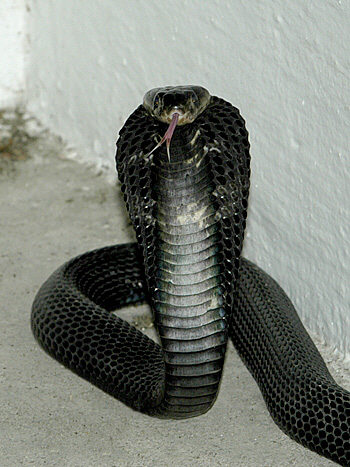
Equatorial spitting cobra
looking fierce
Cool, terrifying, whatever you want to call them, spitting cobras are unarguably fascinating. They are a group of cobra species that have the ability to “spit” their venom from their fangs. They are similar to other cobra species, aside from this odd defense mechanism. They have similar eating and mating habits and are also alike in appearance. It's tough to tell the difference, but it's good to avoid cobras whether they prefer to spit or bite, anyway.

There are currently eleven known species of spitting cobras on Earth. Their color, markings and size differ greatly between the species. The difference in size can be several feet. Some spitting cobras are only a few feet long, while the largest spitting cobra ever found was more than nine feet in length. Spitting cobras can be red, brown or black, with or without markings. However, they do have one feature in common; all spitting cobras are hooded, like the king cobra.

An interesting fact about spitting cobras is that they do not actually spit their venom; technically it is sprayed out of their fangs. After the snake uses its muscles to force the venom into its fangs, it uses a burst of air from its lungs to propel the venom out of its mouth. They do this mainly as a way to defend themselves, and they can aim their venom rather accurately when threatened. The venom that is expelled from the snakes fangs can travel up to ten feet.

Most spitting cobras are equipped with hemotoxic and neurotoxic venom. This venom is harmless if it lands on unbroken skin. However, you should be careful not to touch or spread the venom and to wash it off carefully. If the venom enters the blood stream through broken skin, it can be deadly. A spitting cobra will often aim for the eyes, which can be a problem if it hits its target. The venom can cause complete and permanent blindness if it isn’t treated properly.

Spitting cobras are also capable of delivering their venom through a bite. They will typically use this method for prey only, but the bite is dangerous for the unlucky who are on the receiving end. The large brown spitting cobra is particularly dangerous as it can potentially deliver more venom per bite than any other snake species on Earth.

The large brown spitting cobra is the most recent discovery among spitting cobra species. It is also the biggest and most deadly. Its venom is not as toxic as the king cobra, but far more can be delivered in one bite. There may be even more spitting cobras out there, just waiting to be discovered, but it is doubtful that any can deliver as much venom as the large brown.