Showing posts with label Cryptozoology. Show all posts
Showing posts with label Cryptozoology. Show all posts
Wednesday, October 12, 2016
The Beast of Bray Road: A Curious Cryptid
The Beast of Bray Road is a creature that witnesses claim to have seen in Racine, Walworth and Jefferson counties in Wisconsin. The first reported sightings of the creature happened on Bray Road near Elkhorn, Wisconsin. These sightings are what lent the beast its name. However, sightings do not only occur on Bray Rd. In fact, the beast has not been sighted there since the early 1990s.
No one knows what the Beast of Bray Road, also known as Manwolf, is. Some people believe it is a werewolf, others that it is a Bigfoot and, of course, there are people who believe that it is some heretofore-unknown species. There really is no way to know unless a specimen is found. There is also the possibility that they Beast of Bray Road is, in fact, some creature that we are well aware of that simply scared some people enough that they believed it was something bigger and scarier than it really is. Common theories as to what known animal the beast could be include wolves and bears.
The creature is described as around 6 ft. tall with grayish and brown fur. Its face is said to resemble a wolf, and its ears are pointed. It has three long claws on each hand/paw. It has shiny yellow eyes. Its body has been likened to that of a lean, muscular man that tends to sit back on its haunches or kneel.
The Beast of Bray Road can run and walk on all four of its legs or just its hind legs. It has been seen eating its prey or its scavenged carrion in its hands with its palms facing upward. It has never attacked anyone, but some witnesses claim that it has acted aggressively toward them. This aggressive behavior includes running at people and jumping on their vehicles. The creature’s diet is not known for sure, but it has been seen eating the carcasses of small road kill.
Sightings of the Beast of Bray Road may go back as far as the 1930s. However, it wasn’t sighted frequently or reported thoroughly until 1989 through 1992. Most of the sightings have occurred when one or more people stumbled upon or drove past the animal while it was eating or possibly hunting/scavenging. Sightings of the animal have tapered off since the 90s, but the creature can supposedly still be seen in the woods of the area.
Perhaps the Beast of Bray Road is some cousin of other cryptids in the United States. Alternatively, it could simply be an animal that has yet to be classified or captured, which would make it a true cryptid. It could also be a group of wild animals that has become so adjusted to human life that individuals feel comfortable approaching people and vehicles. It could also be that people are frightened enough to see more than what is really there. Whatever the Beast of Bray Road is or isn't, we will never know until one is captured or it is conclusively proven that the Beast of Bray Road is a case of mistaken identity, which would be difficult to do.
Sources
Creature History, Evidence and Happenings, retrieved 11/24/09

Tuesday, January 26, 2016
Cadborosaurus: North America's Loch Ness Monster
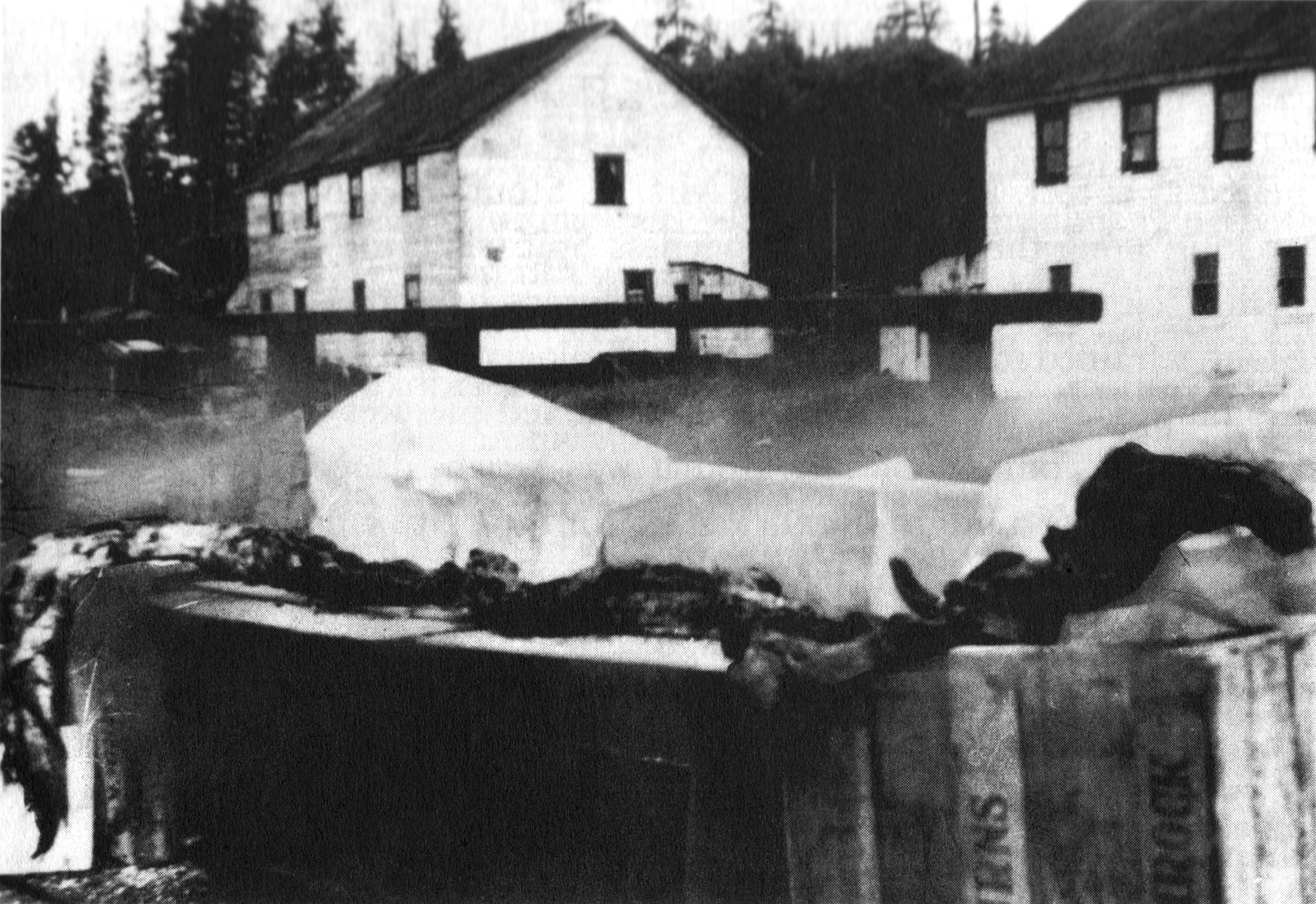 |
| Alleged Cadborosaurus carcass |
In the northern waters of the
Pacific, on the western coast of North America, there have been sightings of a
creature that is similar to the Loch Ness Monster for more than a thousand
years. This creature has reportedly been sighted off of the coast of Canada
frequently and has even been reported in Alaskan waters and as far south as
Monterey Bay in California. This creature is known as the Cadborosaurus and it
is presumably a sea serpent. The only evidence of the existence of the Cadborosaurus
are reported sightings, so the creatures very existence is a mystery. However,
like many other sea serpent sightings in other parts of the globe and
throughout history, it is hard to ignore due to the number of these sightings.
The Cadborosaurus is known by
several monikers in many different places. Its other names include, Caddy,
Pal-Rai-Yuk, Klematosaurus, Sarah the Sea Hag, Saya-Ustih, Hiyitlik,
Tzarta-saurus, Sisiutl, Penda, Amy, Kaegyhil-Depgu’esk and Say Noth-Kai.
Despite the many names that this creature is known by, descriptions of the
animal by witnesses are very similar. Of course, there are subtle differences,
but researchers believe that there may be subspecies of Cadborosaurus or that
its appearance changes throughout its life.
The Cadborosaurus is described
as roughly ten feet and more in length. It is said to have the slender,
elongated body of a serpent. Its head is said to look like that of a camel (of
all things). It does have fins, but the number of fins, location and description
of the fins differ. Some people claim to have seen the animal feeding. The
creature has been spotted hunting schools of fish and it has also been seen
eating waterfowl, which it is said to have swallowed whole.
In 1937 a Cadborosaurus was said
to have been found in the stomach of a whale near the Queen Charlotte Islands.
Photos of the find were taken and samples were sent out to experts. One of the
tissue samples was lost and the other was found to be from a fetal baleen
whale. However, eyewitnesses say that there is no way that it could have been a
fetal baleen whale and the pictures of the creature back up this claim. Of
course, pictures are hardly scientific evidence. There are also people who
claim to have caught Cadborosaurus specimens and have had to release them for
one reason or another. Reported sightings and interactions with these animals
are very numerous, but the fact remains that not one carcass, skeleton or live
specimen has been found and identified as a sea serpent.
Throughout recorded maritime
history stories of serpentine creatures being spotted in the ocean and in other
deep waters have been fairly common. The sheer number of these supposed sea
serpent sightings and the number of places that these sightings have occurred
makes it hard to dismiss the existence of sea serpents easily. There is also
the fact that the waters of the Earth are largely unexplored and we certainly
haven’t been able to identify and classify every creature in their depths. So
until we know for sure that we have identified everything in the Earth’s waters
or we find a specimen and are able to study it thoroughly, the existence of
these creatures will remain a mystery and people will continue to search for
the elusive Cadborosaurus.
Sources
Cadborosaurus, retrieved
10/20/09, bc.scc.ca/cadborosaurus
The Cadbrosaurus Watch,
retrieved 10/20/09, qsl.net/w5www/caddy.html+
Subscribe to:
Posts (Atom)