|
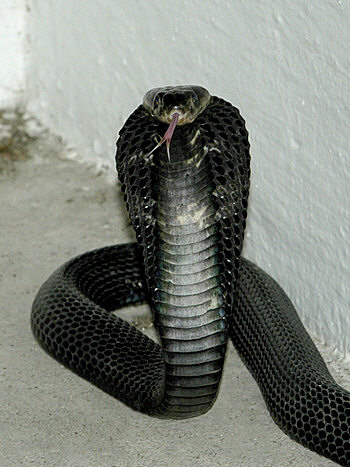
| Western Diamondback Boston Science Museum, 2010 |
The only way to be sure a snake is venomous is to be aware of what the species looks like. There is no universal red flag that tells you a snake is venomous, so be careful. There are four families of snakes that include venomous species. These are the Colubridae, Viperidae, Elapids and Hydrophiidae. Here we will discuss some of the characteristics of each family and some of the venomous species found within these families.
Hydrophiidae
Hydrophiidae are more widely known as Sea Snakes. Every species of Hydrophiidae that has been found thus far is highly venomous. These snakes are very dangerous to humans, so do not disturb them. Usually they would rather not bite you, but they will if they are threatened. It is relatively easy to recognize a Hydrophiidae because they all live in salt water and have flattened tails for swimming.
Colubridae
Colubridae make up around 75% of the world's snake population and it has been estimated that around 20% of them are venomous. Twenty percent may not seem like a lot, but that is hundreds of species of venomous Colubrids. These snakes are found all over the world, so it is a good idea to educate yourself on the Colubrids in your area so that you can tell the difference between a harmless garter snake and a venomous Colubrid.
Viperidae
Every snake species that belongs to the Viperidae family is venomous. They have hinged fangs that fold back when they close their mouths, but inspecting a snake’s teeth is an impractical way to decide if it is venomous. However, many of these species have triangular heads and slender necks. This is not a surefire way to tell if a snake is venomous, but if you see a snake does have this triangular shape to its head, it is a good idea to leave the area carefully.
Species of Viperidae include all rattlesnakes, cottonmouths, the bushmaster, and of course vipers. Pit vipers are recognizable for the pits that appear between their nostrils and eyes. There is one on each side. However, these cannot be seen from a distance. Rattlesnakes are recognizable for the rattles that appear on their tails. Thankfully, they shake these when threatened and it makes a distinctive noise. Unfortunately, young rattlesnakes can deliver a venomous bite, but they only have one rattle and therefore can’t make the telltale sound. Cottonmouths can be recognized when they open their jaws, which they do when they are threatened. The insides of their mouths are white, hence the name.
Elapids
All species of the Elapid family are also venomous. They tend to have shorter fangs that are fixed rather than hinged. This group contains some of the most notorious of the venomous snake species, such as cobras, mambas, kraits, taipans and coral snakes. It is very difficult to tell the difference between a coral snake and the harmless kingsnake, because they both have yellow, black and red bands over the entire length of their bodies. A good way to remember the difference between the two is to use this rhyme, “if red touches yellow, kill a fellow, if red touches black, friend of Jack.”
If you plan to spend time outdoors, pick up a field guide on snakes in that area before venturing into snake territory. If you are unfamiliar with the snakes in an area and come across one, you should treat it as if it were venomous. This means leaving the snake alone and allowing it to wander off or, if the snake is aggressive, you can leave the area immediately, being careful not to step on any other snakes.
Try to bring a friend with you whenever you wander outside; this can be helpful if you are bitten. The unafflicted person should try to remember what the snake looks like so they can describe it to a doctor. Ideally the doctor would like to see the snake, but if you cannot catch the snake safely, don’t try. It is also important to know that recently deceased snakes can still deliver venomous bites.
Sources
Stillwell, Steven E., Snake Mystique, retrieved 7/4/09, buckmasters.com/bm/resources/articles/tabid/135/articleType/ArticleT-d/919/Snake-mystique.aspx
Abby, Michael, “Viperidae” A Dictionary of Zoology 1999, retrieved 7/4/09, encyclopedia.com/doc/108-Viperidae.html
Colubrids:Colubridae-Physical Characteristic, Habitat, Diet, Behavior and reproduction, Colubrids and People, Conservation, staus-GEOGRAPHIC RANGE</a7>,retrieved 7/4/09, http//animals.jrank.org/pages/3893/Colubrids-Colubridae.htm
Garamone, Jim, Dealing with That Snake in the Grass, retrieved 7/4/09, defenselink.mil/news/newsarticle.aspx?id=45207