Showing posts with label Lizards. Show all posts

Wednesday, January 27, 2016

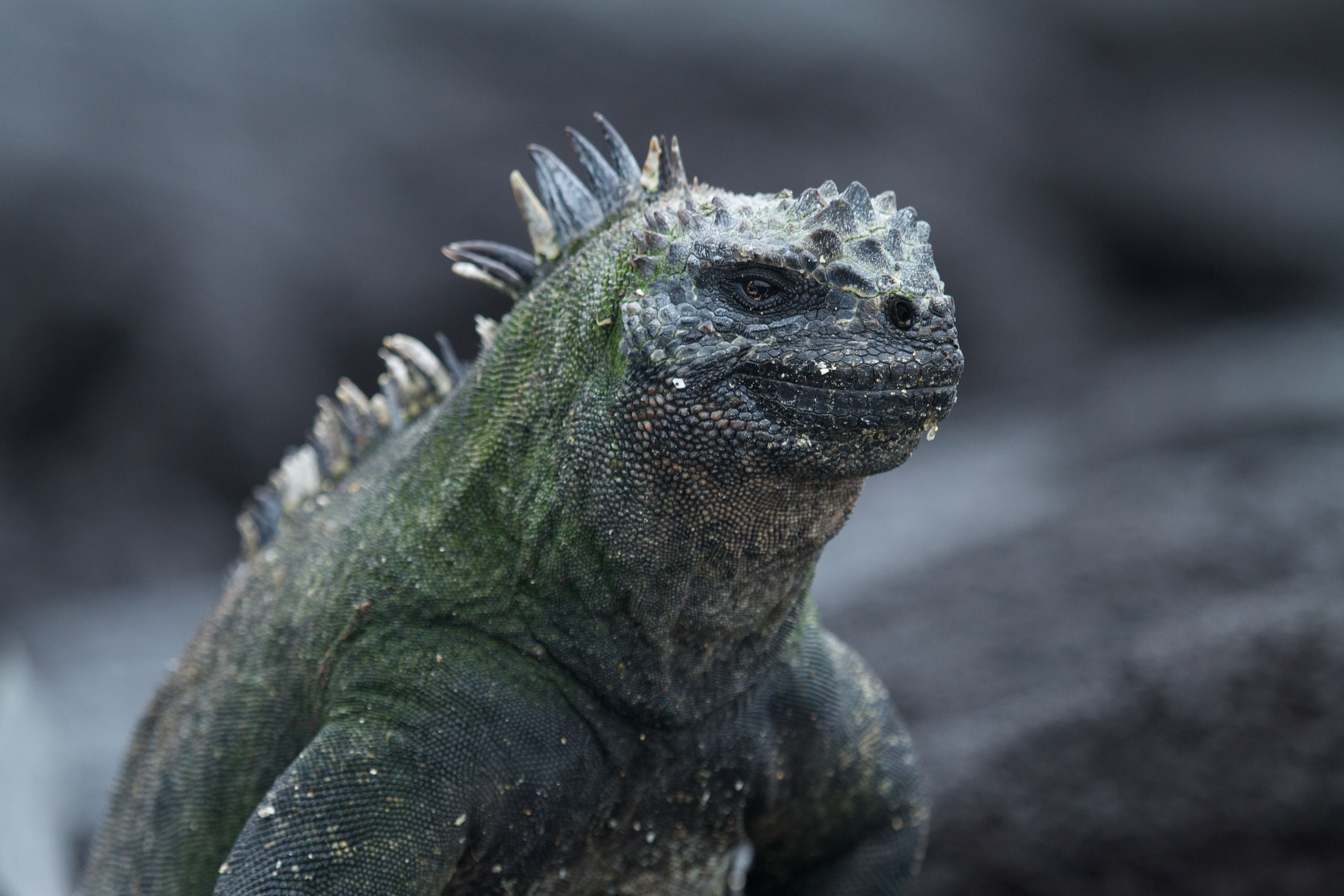
Marine Iguanas: The Lizards of the Ocean

Marine iguana
Marine Iguana
Photo by Brian Gratwicke
Marine Iguanas can be found on the Galapagos Islands. The Galapagos Islands are a volcanic island chain off of the northwest coast of South America. These islands are home to some of the rarest and most unique endemic species on the planet. One of these endemic species is the Marine Iguana. These creatures are the only iguanas on Earth that have adapted to living on the shores of, and feeding in, the ocean.

They have several features that distinguish them from land iguanas. They have short, snubbed noses and flat tails. They have longer and sharper claws than other iguanas.  Larger Maine Iguanas (mostly males), have the ability to dive and stay underwater for more than 30 minutes. They are able to dive in the cold water, despite being cold blooded, because these iguanas have the ability to slow down their heart rate and restrict blood flow in order to preserve heat. The smaller Marine Iguanas are unable to do this because they are not able to retain heat as well as the larger ones.

All of these unique features serve an important purpose for the Marine Iguana. The long, sharp claws are great for clinging to the lava rocks that line the shores of the Galapagos islands. If Marine Iguanas didn’t have these, they could be knocked off of the rocks by waves. Their snubbed noses help them scrape the algae that they eat off of the lava rocks. Their long flat tails  make it easier for the Marine Iguanas to swim. Lastly the larger ones’ ability to dive and stay under water for long periods is allowing them to eat for longer times before basking and it allows them to search for food further from shore.

Unlike many endemic species of the Galapagos, Marine Iguanas can be found on every island of the Galapagos archipelago. All of these iguanas are of the same species, but they do differ from island to island. One example of these differences is coloration. All baby Marine Iguanas are black, as are many of the adults. However, on some of these islands there are examples of bright red or green Marine Iguanas. Variations in the size of these iguanas from island to island have been noted as well.

Marine Iguanas live peacefully together for around ten months out of the year. The other two months they are breeding. While the males are trying to find mates they display territorial behavior and will fight with one another for hours. Once the males have found mates and it is time for the females to nest, it becomes the female’s turn to become aggressive with each another.

Interesting Facts About Marine Iguanas

-Marine Iguanas can shrink. When there are major food shortages these animals can and do shrink. What is interesting about this fact is that they not only get thinner, but they also lose a significant amount of length. 

-Marine Iguanas crowd together in large groups on the shores of the Galapagos at night to keep warm.

-Marine Iguanas sneeze salt. Special glands collect the salt when the animal takes in seawater while feeding. Every so often they get rid of the built up salt by sneezing. These salt bogeys often land right back on the iguanas head, where they dry up and turn the iguanas head white.

-They are the only iguanas on Earth that can feed in the ocean and depend on it for food.

These iguanas are not endangered, but they are vulnerable to changes in the ocean’s temperature. Also, animals that have been introduced to the islands, such as cats and dogs can and do feed on these iguanas. If these introduced species are kept under control and the currents in the area do not change, these interesting creatures may be around for a while yet. 

Sources

Marine Iguanas, retrieved 6/15/09, geocornell.edu/geology/GalapagosWWW/MarineIguanas.html


Galapagos Marine Iguanas, 2002, retrieved 6/15/09, kidcyber.com.au

Wednesday, January 20, 2016

Komodo Dragons: The Biggest Lizards on the Planet

Komodo Dragon
Komodo Dragon
Photo by Raul 654
Komodo Dragons are the largest and heaviest lizards living on Earth. They are not only found on the island of Komodo, but also on the islands of Flores, Rinca and Gili Motang. However, they cannot be found outside of Indonesia. These impressive animals are capable, fierce and fast hunters.

Komodo Dragons are a species of Monitor Lizard, though they are much bigger than any of their cousins. An adult Komodo Dragon can be up to 10 feet in length and weigh around 150 pounds. There have been reports of heavier specimens, but because these lizards can eat up to 80% of their body weight in one feeding, these weights may be attributed to undigested food.

At night, Komodo Dragons sleep in holes that are 3-10 feet wide. This is a way of regulating their body’s temperature because, like other lizards, Komodo Dragons must thermoregulate their body temperature in order to survive. They have also been known to ambush prey from these holes. 

Komodo Dragons are carnivorous and adults will eat just about anything that moves and is large enough. They also eat any carrion that they come across, including dead humans. Larger prey is ripped apart by this giant lizard’s teeth and the pieces are swallowed without chewing. Smaller prey (like goats) are swallowed hole. Komodo Dragons have been observed forcing prey down their throats by slamming the protruding portion of their meal against a tree. 

Komodo Dragons actively hunt and ambush their prey. Their bites are toxic, so if they succeed in biting an animal that later gets away, chances are it will die within days and become food for a Komodo Dragon anyway. This lizard’s poisonous bite has been attributed both to bacteria in the animal’s mouth as well as venom produced by glands in the animal’s head. Komodo Dragons seem to be impervious to each others venom/bacteria.

Mating happens between May and August. The females lay their eggs in September and they hatch in April. The eggs incubate for roughly eight months. The female stays with the nest until the eggs hatch. Male Komodo Dragons will fight with other males over potential mates. They will stand on their hind legs and wrestle until one of them gives up. Female Komodos can reproduce without a male, though parthenogenesis in Komodo Dragons only produces male offspring.

Juvenile Komodo Dragons are susceptible to being eaten by cannibalistic adults. They will spend most of their time up in trees and eat mostly insects at this time. As they grow, they will approach feeding sites and roll around in feces to deter the older Komodo Dragons.

When Komodo Dragons are hungry, they have been known to eat humans, though this is rare. They have also been known to dig up fresh corpses to dine on. They can run about as fast as an average human adult, so entering their territory unprepared is inadvisable.

Sources

Komodo Dragons, retrieved 6/17/09, nationalzoo.si.edu/animals/reptilesAmphibians/facts/factsheets/Komododragon.cfm
Komodo Dragons, retrieved 6/17/09, indyzoo.com/content.aspx?CID=1251


Komodo Dragons, retrieved 6/17/09, tolweb.org/treehouse/?treehouse_id

Thursday, January 14, 2016

Interesting Facts About Chameleons

Chameleon drawing
When people think of chameleons, they often think of lizards that can change color on a whim to blend in with their surroundings. This is not entirely true, and it is also not the only thing about chameleons that is unique and interesting. These lizards have evolved with some very strange characteristics that set them off from their cousins in the lizard world. The following are just a few interesting facts about chameleons that you may not have known.

Chameleons have feet that are much more like those of birds than they are like other lizard’s feet. Their feet are zygodactyl. This means that they have two pincer-like ‘fingers’ sticking out toward the rear and two toward the front on each foot. These zygodactyl feet make it easy for chameleons to hold on to branches and twigs, where they spend a lot of their time.

Another thing that aids in a chameleon’s ability to hold on to and climb branches and twigs are their prehensile tails. Their tails are like monkey tails in that they can wrap them around things and hold on with them. Not all chameleons have this characteristic, but many do.

Chameleons have very long tongues that aid in their hunting. Most chameleon species have tongues that are nearly as long as the lizard’s body. There are also some chameleons that have tongues that are up to twice as long as the animal they are attached to.

Chameleons are not the only lizards in the world that can change their color. However, they do have the most diverse, drastic and vibrant colors and color changes. They are able to do this because of several layers of cells that are located beneath their clear skin. Some of these cells contain pigment while others are capable of reflecting the color from light. These cells react to the chameleon’s mood, the temperature of its environment, and the amount of light available. Contrary to popular belief, chameleons are not able to change their color at will to match their surroundings. Their color does change to help them blend in at times, but a very calm chameleon would have a difficult time blending in with white surroundings because a very calm chameleon is typically all green. 

Chameleons can move each of their eyes independently of the other one. This means that a chameleon can focus on two potential food sources at once and they can be in just about any direction. This is actually a rather cute feature of the chameleon. They can look kind of goofy when they are moving their eyes about.

There are roughly 134 known chameleon species on Earth. Nearly half of them can only be found on the island of Madagascar, fifty-nine of them to be exact. This is yet another good reason why habitat conservation on the island is of the utmost importance.

As you can see, chameleons are some of the coolest, most interesting lizards in the world. There is even a species of chameleon whose head looks like that of a triceratops. It doesn’t get much more interesting than that.

Sources

Chameleon, retrieved 3/9/10, animals.howstuffworks.com/reptiles/chameleon-info.htm

Raxworthy, Christopher, A Truly Bizarre Lizard, retrieved 3/9/10, pbs.org/edens/madagascar/creature3.htm


Friday, January 8, 2016

Galapagos Land Iguana

Galapagos land iguana
Galapagos Land Iguana
Photo by Peter Wilton
Among the amazing animals that can be found on the famous Galapagos Archipelago are two species of land iguanas. The more common of the two is the Conolophus subcristatus and it can be found on Fernandina Island, Isabela Island, Santa Cruz Island, North Seymour Island, Hood Island and South Plaza Island. The second is the Conolophus pallidus and it can only be found on Sante Fe Island.

Galapagos land iguanas are yellow, orange or a mix of the two. They have blunt heads and long, tapering tails. These iguanas have short legs and long, sharp claws. A row of spines runs down the center of the neck and down the back. They are relatively large iguanas with adult males being up to 3.2 feet long and weighing up to 28 pounds.

Galapagos land iguanas do have specific time frames for breeding. However, this time depends on the island on which the iguana dwells. After mating, the female iguana will wander off to dig a nest in sandy or loose soil, which she will protect for a few days before abandoning it. The female lays anywhere from 2-25 eggs; the eggs will incubate for three to four months. When the eggs hatch, it will take the young about one week to dig their way out of the nest. The young are very vulnerable to predation, but may live more than 50 years, if they get past the first couple. It will take them between 8 and 15 years to reach adulthood, depending on their size.

Galapagos land iguanas are omnivorous. However, their primary source of food is the plant life of their respective islands, particularly, cactus and fallen fruit. Younger iguanas are a source of food for other animals on the islands such as cats, heron, hawks and snakes. Cats will eat the eggs and can feed on land iguanas until they are about four years old, at which time they become too big for the cats. The rest of the animal’s predators can only eat smaller specimens that are up to a year old. Adult Galapagos land iguanas have no natural predators.

These animals are only active during daylight hours. They bask in the sun during the morning, but spend the hottest hours hiding in the shade. At night they sleep in burrows which they dig in the earth. Males of these two species are territorial and do display aggression. When their territory is being encroached upon by another male, they may bob their head up and down or bite the other animal. Another interesting behavior that these animals display is their symbiotic relationship with Darwin’s finches. When a Galapagos land iguana has ticks, it may lift its body up off the ground so that one of these birds can eat the ticks.

Unfortunately, like so many other species on these beautiful islands, the Galapagos land iguana is in need of conservation. They are listed as Vulnerable on the IUCN Red List and they are threatened by invasive species. There are conservation efforts underway at this time. However, the species population has dwindled so much that some of the islands where they were abundant are no longer host to these creatures. Hopefully with a little care on our part and a little more effort for their sake, this won’t happen on any more of the islands in the Galapagos.

Sources

Galapagos Land Iguanas, retrieved 11/07/09, gct.org/iguana.html


Galapagos Land Iguana, arkive.org/galapagos-land-iguana/conolophus-subcristatus/info.html